

You spend roughly 18,250 mornings getting dressed for work over a 50-year career. If you lose 10 minutes daily staring at a closet full of clothes you don’t actually wear, that’s 3,041 hours—or 126 full days—of your life gone. Not spent deciding. Wasted. A 20-item work wardrobe eliminates that math entirely.
I tested this for six months. The result: I get dressed in under 90 seconds now. No more trying on three shirts, swapping pants, and settling for something I hate. The system works because it removes choice from the equation. You only own clothes that fit, match, and make you look competent.
What Counts in a 20-Item Work Wardrobe (And What Doesn’t)
Before you start pulling clothes out of your closet, you need a definition. A 20-item work wardrobe means 20 pieces of clothing and outerwear that you wear to work. It does not include shoes, accessories, underwear, or loungewear. Those are separate categories with their own limits.
Here’s the breakdown I used:
- Tops: 8 items (blouses, button-downs, fine-knit sweaters)
- Bottoms: 5 items (trousers, skirts, tailored pants)
- Layers: 4 items (blazers, cardigans, a structured jacket)
- Dresses: 2 items (one sheath, one shift)
- Outerwear: 1 item (a wool coat or trench that works over everything)
That’s 20. No exceptions. The moment you allow a 21st item, the system collapses. I learned this the hard way when I kept a “just in case” blouse. I never wore it. It hung there, mocking me, taking up mental space.
Why 20 Is the Right Number
Twenty items create approximately 1,900 possible outfit combinations. That’s more than you’ll ever need for a five-day workweek. But the number matters less than the constraint. A hard limit forces you to keep only what earns its place. No sentimental pieces. No “someday when I lose five pounds” pants. No impulse buys that don’t coordinate.
The math is simple: if you wear 5 outfits per week and do laundry every 7 days, you need exactly 5 tops and 5 bottoms that all work together. The remaining 10 items cover layering, dresses for variety, and weather changes. That’s the entire logic.
The Curation Framework: How to Pick Your 20 Pieces Without Losing Your Mind
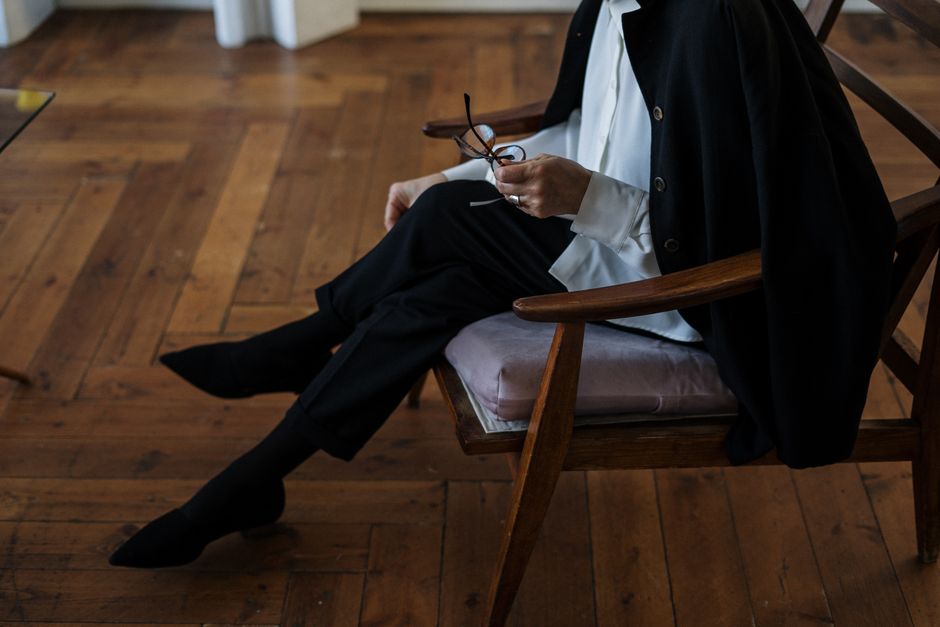
Most people fail at this because they start by asking “What do I like?” That’s the wrong question. Start with “What do I actually wear?” Pull your laundry from the last two weeks. The clothes you reached for repeatedly are your real wardrobe. Everything else is decoration.
Here’s the step-by-step process I used, and it took one Saturday afternoon:
- Empty your closet completely. Every single work-appropriate item goes on the bed. If you can’t see it, you can’t evaluate it.
- Sort into three piles: “Worn in the last 30 days,” “Worn in the last 90 days,” and “Not worn in 6+ months.” Be honest. The third pile is dead weight.
- Check the 90-day pile for fit issues. If something doesn’t fit right now—not after a diet, not with different shoes—it goes. Clothes that don’t fit are not clothes. They’re promises you keep breaking.
- Apply the 3-color rule. Pick three base colors that all coordinate: two neutrals (black, navy, gray, beige, camel) and one accent (burgundy, forest green, rust, soft blue). Every item must match at least two of your three colors. This is the single most important rule. It’s why my wardrobe works.
- Count what remains. If you have more than 20, cut ruthlessly. If fewer, you have room to fill gaps intentionally.
My three colors are black, camel, and burgundy. Every top works with every bottom. Every layer works over every top. That’s the whole trick. You don’t need a fashion degree. You need a color constraint.
The Most Common Curation Mistake
People try to keep “versatile” items that are actually boring. A white button-down is versatile only if you iron it. A black blazer works only if it fits across the shoulders. The test isn’t whether an item could work in theory. It’s whether you actually reach for it on a rushed Tuesday morning. If you don’t, it’s not versatile. It’s aspirational.
What a Real 20-Item Work Wardrobe Looks Like
Here’s my actual list, with specific products, so you can see the framework in practice. This is not a theoretical capsule. This is what I wore for six months at a business-casual office.
| Category | Item | Brand / Product | Why It Earned a Spot |
|---|---|---|---|
| Top | White silk-blend button-down | Everlane Clean Silk Shirt ($98) | Wrinkles less than cotton, looks polished under any blazer |
| Top | Navy fine-knit sweater | Uniqlo Extra Fine Merino Crewneck ($39.90) | Machine washable, no pilling after 20+ washes |
| Top | Black fitted turtleneck | J.Crew Tissue Turtleneck ($49.50) | Layerable, works with all 5 bottoms |
| Top | Camel silk blouse | Quince Washable Silk Blouse ($49.90) | Adds warmth to the palette, ties the color story together |
| Top | Burgundy ribbed sweater | & Other Stories Ribbed Knit ($69) | The accent piece that makes outfits look intentional |
| Top | White cotton poplin shirt | Brooks Brothers Non-Iron Shirt ($89) | For days when I need to look more formal |
| Top | Gray cashmere crewneck | Naadam Essential Cashmere Sweater ($75) | Soft, warm, works under blazers without bulk |
| Top | Black sleeveless shell | MM LaFleur Woolf Top ($85) | The workhorse under blazers and cardigans |
| Bottom | Black tailored trousers | Everlane Dream Pant ($88) | Pull-on waist, looks tailored, machine washable |
| Bottom | Camel wide-leg trousers | Aritzia Effortless Pant ($148) | The silhouette that makes every outfit look current |
| Bottom | Gray wool skirt | J.Crew A-Line Skirt ($79) | Works with tights in winter, bare legs in summer |
| Bottom | Navy tailored pants | Banana Republic Sculpted Pant ($98) | Second neutral, breaks up all-black outfits |
| Bottom | Black midi skirt | Quince Silk Slip Skirt ($59.90) | Dresses up or down, packs well for travel |
| Layer | Black blazer | J.Crew Going-Out Blazer ($168) | Fits well without tailoring, structured shoulders |
| Layer | Camel cardigan | Uniqlo Cashmere-Blend Cardigan ($59.90) | Softer alternative to a blazer on casual days |
| Layer | Navy structured jacket | Mango Wool-Blend Jacket ($119) | Adds polish without the formality of a blazer |
| Layer | Gray longline vest | Zara Tailored Vest ($69.90) | The 2026 layering piece that updates everything |
| Dress | Black sheath dress | MM LaFleur Etsuko Dress ($225) | One-piece outfit, zero thought required |
| Dress | Camel shift dress | Everlane The Shift Dress ($98) | Works with blazer, cardigan, or alone |
| Outer | Black wool coat | Reiss Wool-Blend Coat ($350) | Goes over everything, handles 3 seasons |
Total cost if you bought everything new: roughly $1,800. That sounds like a lot until you calculate cost per wear. I’ve worn the Everlane Dream Pants at least 80 times in six months. That’s $1.10 per wear. The blazer? $1.68 per wear and dropping. Compare that to the $40 “trendy” top you wear three times and abandon. That’s $13.33 per wear. The math favors a curated wardrobe every single time.
When a 20-Item Wardrobe Fails (And What to Do Instead)

I’m going to be direct: this system does not work for everyone. If you work in a formal office where suits are required, 20 items is not enough. A proper suit rotation needs at least 3 suits, which eats 9-12 items immediately. You’d need a 30-item wardrobe minimum, and that’s okay. The principle—constraint, coordination, intentionality—still applies. The number changes.
If you live in a four-season climate with extreme temperature swings, 20 items won’t cover you year-round. You need a seasonal rotation: 20 items for cold months, 20 for warm, with overlap pieces. My six-month test covered fall and winter. I’m currently building the spring/summer capsule, and the rules are the same. Three colors. Everything matches. Hard limit.
If your job requires frequent client-facing events with different dress codes, you need more flexibility. A 20-item wardrobe works best for a consistent dress code—business casual, smart casual, or a single formal standard. If you’re juggling three dress codes weekly, you’ll need to subdivide: 20 items for office days, a separate evening-event capsule, a separate travel capsule. The mistake is trying to make one wardrobe do everything.
What I’d Cut if I Had to Do It Again
The gray cashmere crewneck. I wore it twice. It’s beautiful, but it’s redundant with the navy merino sweater. I kept it because I loved it, not because I needed it. That’s the failure mode to watch: keeping items for emotional reasons while calling them “versatile.” Be honest about the difference. If I could redo my curation, I’d swap the cashmere for a second pair of black trousers. Bottoms wear out faster than tops, and having a backup pair would have saved me a mid-season emergency purchase.
The Morning Routine That Makes It Work

Here’s the part nobody tells you: a curated wardrobe only solves half the problem. The other half is a decision framework for getting dressed. Without a system, you’ll still stare at your 20 items wondering what to wear. The difference is you’ll now own the indecision.
My routine, honed over six months:
- Check the weather app. This determines the layer and the bottom. Rain means trousers, not skirts. Cold means the cashmere, not the silk.
- Pick the bottom first. Bottoms are the anchor. Everything else follows.
- Pick the top based on the bottom’s color. If I’m wearing camel trousers, I reach for the black turtleneck or the burgundy sweater. If black trousers, the camel blouse or the white button-down.
- Add one layer. Blazer for meetings, cardigan for desk days, vest for something current.
- Done. No second-guessing. No changing. The outfit is fine because every combination is fine.
The whole process takes 90 seconds. I timed it. The key is step 5: you must trust the system enough to not second-guess. The first two weeks feel weird. You’ll want to change. Don’t. By week three, the habit forms, and you’ll notice something strange: you stop thinking about clothes at all. That’s the goal. Not a better outfit. Less time spent thinking about the outfit.
The single most important takeaway: a 20-item work wardrobe doesn’t make you more stylish—it makes you faster, and speed is the only luxury that actually compounds.