
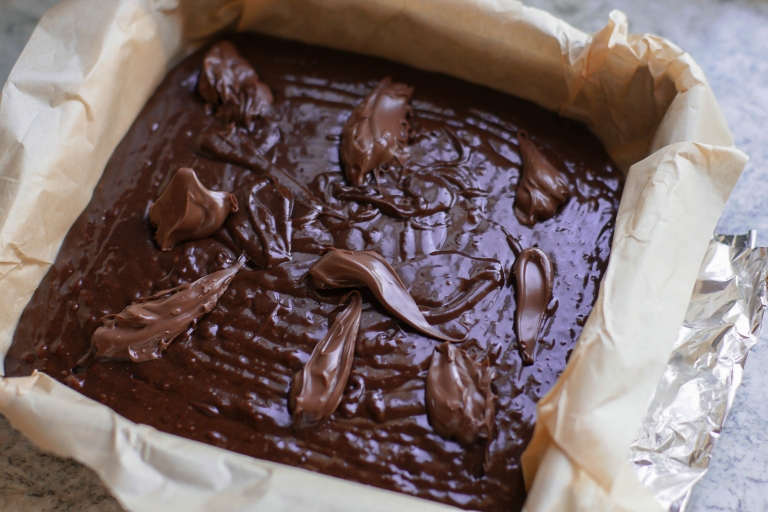
You have 45 minutes, one bowl, and a craving that won’t quit. No stand mixer. No double boiler. No thermometer. This recipe is for exactly that situation — and it delivers brownies with a crackly top, a dense fudgy center, and edges that pull cleanly from the pan every time.
Why Most “Easy” Brownie Recipes Fail You
Here’s what actually happens with most beginner brownie recipes: they call for melted chocolate AND cocoa powder, three separate bowls, or folding steps that somehow make everything go wrong. You end up with cakey bricks. Not gooey. Not what you wanted.
The gooiness in a brownie comes from two things. Fat-to-flour ratio and bake time. That’s it. No secret ingredient. No technique borrowed from a pastry school.
A gooey brownie has a fat-to-flour ratio of roughly 2:1 or higher by weight. A cakey brownie flips that. The recipe below uses 1 cup (225g) of butter with just 3/4 cup (95g) of flour — that ratio is how you get fudge-adjacent texture without actually making fudge.
The second factor is when you pull them from the oven. Take them out when a toothpick comes out with wet crumbs — not clean. A clean toothpick means you’ve already overbaked by 5 minutes.
Most failed brownie attempts trace back to two specific errors: using too much flour, and baking until “done” instead of baking until just set.
The flour problem is common and fixable. Scooping the measuring cup directly into the flour bag packs it down, adding 20–30% more than the recipe intends. Instead, spoon flour into the cup with a separate spoon and level it off with a knife. Or use a kitchen scale. The OXO Good Grips 11-pound digital kitchen scale ($30) is accurate to 1 gram and eliminates the guesswork entirely — worth owning if you bake more than twice a year.
There’s also the pan problem. A glass 9×13 pan bakes slower than a metal one. A dark metal pan runs hot and can scorch the bottom before the center sets. The best pan for this recipe is a light-colored aluminum 8×8 or 9×9 square pan. USA Pan makes an 8×8 aluminized steel pan for around $18 that produces consistent results and releases cleanly with parchment. If you’re using a 9×13, reduce baking time by 8 minutes — thinner batter, faster bake.
One more thing: cold eggs. Adding refrigerator-cold eggs directly to hot melted butter risks partially cooking the eggs before they blend in. Room temperature eggs mix smoother. Leave them on the counter for 15 minutes or submerge in warm water for 5 minutes.
Once you know these failure points, brownie baking becomes predictable. Nothing mysterious about a perfect batch — just fat, timing, and temperature working in your favor.
The Full Recipe: 8 Ingredients, One Bowl
Makes 16 brownies in an 8×8 pan. Active time: 15 minutes. Bake time: 25 minutes.
- Melt 1 cup (225g) unsalted butter in a large microwave-safe bowl in 30-second bursts, stirring between each. Takes about 90 seconds total. Let cool for 5 minutes so it’s warm, not hot.
- Whisk in 2 cups (400g) granulated sugar until fully combined. The mixture looks grainy at this stage — that’s expected.
- Add 4 large eggs and 2 teaspoons vanilla extract. Whisk hard for 60 seconds. This step creates the shiny crackly top. Don’t rush it.
- Stir in 3/4 cup (75g) unsweetened cocoa powder, 3/4 cup (95g) all-purpose flour, and 1/2 teaspoon salt. Switch to a spatula. Mix until just combined — a few flour streaks are fine. Overmixing builds gluten and toughens the final texture.
- Pour into a parchment-lined 8×8 pan. Spread into an even layer with the spatula.
- Bake at 350°F (175°C) for 23–26 minutes. Check at 23 minutes. A toothpick inserted at the center should come out with moist crumbs attached — not wet batter, not clean.
- Cool in the pan for 30 minutes before cutting. The interior continues to set as it cools. Cut too early and the brownies fall apart at the center.
- Lift out with parchment, set on a cutting board, and slice with a sharp chef’s knife. Wipe the blade between cuts for clean edges.
That’s the complete recipe. Eight ingredients, one bowl, consistent results every time. If you want slightly thicker brownies, use a 7×7 pan and increase bake time to 30–32 minutes — the thicker batter holds more heat and stays gooier at the center.
Which Chocolate to Use (And Which to Skip)
This recipe uses cocoa powder, not melted chocolate bars — which is part of why it’s fast. But cocoa quality changes the flavor noticeably. Here’s how the main options compare:
| Cocoa Powder | Type | Flavor Profile | Best For | Price |
|---|---|---|---|---|
| Hershey’s Natural Unsweetened | Natural (acidic) | Bright, slightly fruity | Classic everyday brownies | $4 / 8oz |
| Hershey’s Special Dark | Dutch-process blend | Deep, dark, smooth | Best everyday value pick | $5 / 8oz |
| Droste Cacao | Dutch-process | Mellow, European-style | Sophisticated flavor | $9 / 8.8oz |
| Ghirardelli Premium Baking Cocoa | Unsweetened | Bold, slightly earthy | Wide availability, reliable | $7 / 8oz |
| Valrhona 100% Cacao | Dutch-process | Intensely complex, floral | Gift-quality brownies | $15 / 8oz |
Hershey’s Special Dark is the pick for everyday baking. The Dutch-process blend gives deeper color and smoother bitterness without spending $15 on Valrhona. Save the Valrhona for when you’re gifting the brownies or baking for someone who will actually notice the difference.
Can You Substitute Chocolate Bars?
Yes. Replace the 3/4 cup cocoa with 4oz (113g) melted dark chocolate — Ghirardelli 72% Cacao Baking Bars work well and cost around $4 at most grocery stores. Reduce the butter by 2 tablespoons to account for the added cocoa butter. Melt the chocolate with the butter in step one. The texture becomes slightly denser and more truffle-like. A good way to use up a baking bar sitting in your pantry.
What About Milk Chocolate?
Skip it here. Milk chocolate typically contains 30–40% cocoa solids versus 70%+ in dark chocolate, with significantly more sugar. Adding it throws off the sweetness balance and makes an already-sweet recipe cloying. If you want milder chocolate flavor, reduce the cocoa to 1/2 cup rather than swapping in milk chocolate.
The Single Step That Determines Everything
Pull them out early. Set your timer for 23 minutes and check with a toothpick at the center. Wet crumbs on the toothpick means you’re right on time. A clean toothpick means they’re already overbaked. There’s no fixing an overbaked brownie — drier, crumblier, less fudgy. This one decision matters more than every other variable in this recipe.
Baking Questions, Answered Specifically
Why do my brownies come out cakey instead of gooey?
Three likely causes. First, too much flour — a scooped measuring cup can easily be 130g instead of 95g. Use the spoon-and-level method or weigh it on a scale. Second, too large eggs — if your eggs are extra-large, try 3 whole eggs plus 1 yolk instead of 4 whole eggs. Third, overmixing after adding flour builds gluten that tightens the structure. Stir only until no dry streaks remain.
Why doesn’t my brownie have a shiny crackly top?
The crackly top forms when sugar dissolves fully and rises to the surface during baking. This requires vigorous whisking after you add the eggs — at least 60 solid seconds, not a gentle stir. The mixture should look slightly thicker and more homogenous before you add the flour. Also: if your butter was still very hot when you added the eggs, it may have partially set the egg proteins before they incorporated. Let the melted butter cool to warm before proceeding.
Can the recipe be doubled?
Yes. Use a 9×13 pan and bake at 350°F for 30–35 minutes. Same toothpick test at the center. A doubled batch in a 9×13 spreads thinner than a single batch in an 8×8 — if you want thick brownies, bake two separate 8×8 pans instead of scaling up to a larger pan.
How do you store them?
Room temperature, covered tightly, up to 4 days. Avoid the refrigerator — cold air dries the texture out fast. For longer storage, freeze individual squares wrapped in plastic wrap inside a freezer bag. They thaw in 30 minutes at room temperature or 20 seconds in the microwave. Frozen brownies hold flavor well for up to 3 months.
Mix-Ins That Actually Work
The batter is dense, which means heavy additions sink and delicate ones vanish. Keep it to one mix-in per batch. These five hold up consistently:
- Chocolate chips: Fold in 1/2 cup Ghirardelli 60% Cacao Bittersweet Chips just before pouring into the pan. They melt slightly during baking but hold enough structure to create pockets of chocolate in each bite. Use bittersweet, not semi-sweet — semi-sweet pushes the sweetness too far.
- Toasted walnuts or pecans: 1/2 cup, roughly chopped. Toast at 350°F for 8 minutes before folding in. Pecans add buttery richness; walnuts add slight bitterness that balances the sweetness. Raw nuts in baked goods taste flat — toasting is not an optional step.
- Flaky sea salt: Sprinkle Maldon Salt flakes on top right before the pan goes into the oven. Not mixed into the batter — on the surface only. The salt-and-chocolate contrast hits first and makes the chocolate flavor read as more intense.
- Espresso powder: 1 teaspoon added with the cocoa in step four. You won’t taste coffee — espresso amplifies chocolate flavor without contributing a coffee flavor. King Arthur Baking sells espresso powder specifically formulated for this purpose, about $6 for a small tin.
- Peanut butter swirl: Drop 4–5 tablespoons of room-temperature creamy peanut butter on top of the poured batter, then drag a butter knife through it in two passes. Don’t overmix the swirl or it disappears into the batter entirely.
A note on timing: add mix-ins at the very end, just before pouring into the pan. Letting them sit in the batter while you prep the pan — even 5 minutes — causes them to absorb moisture from the batter, which changes the final texture in ways that are hard to predict.
When Box Mix Beats From Scratch
Ghirardelli Double Chocolate Brownie Mix makes better brownies than most from-scratch recipes written by home bakers. It’s calibrated by food scientists, uses quality cocoa, and is nearly impossible to mess up. At $5 for a box that yields 16 brownies, it’s also cheaper than buying individual ingredients in small quantities if you don’t already have them stocked.
Use box mix when:
- You’re baking for a large group and scaling a from-scratch recipe introduces variables you’d rather not troubleshoot
- You don’t regularly keep cocoa powder or vanilla extract on hand
- Someone with limited baking experience is doing the cooking
- You need brownies in under 35 minutes with minimal cleanup
Use from scratch when you want control over sweetness and chocolate intensity, when you plan to add specific mix-ins, or when the person you’re baking for will taste the difference. The from-scratch version above is less sweet than most box mixes and noticeably darker in flavor. Those qualities matter when someone is paying attention.
For a weeknight craving, Ghirardelli box mix is a completely defensible choice. For a dinner party or a homemade gift, from scratch earns its extra 10 minutes.
Brownie recipes will keep evolving — better single-origin cocoas hitting the mass market, new techniques for that fudge-dense center without a water bath. But the fundamentals stay fixed: fat ratio, bake time, cocoa quality. Get those three variables right and every recipe, box or scratch, becomes predictable.