

You arrive at your desk wearing a fine-gauge sweater under a rigid jacket, then spend the first hour tugging at the armholes. The problem is not your shirt. It is the shoulder construction. Soft-shoulder blazers remove some of that stiffness while keeping enough shape for meetings, commuting, and a normal workday.
Why soft shoulders solve late-winter office layering
Late winter creates a narrow clothing problem. Outdoor temperatures still demand insulation, but most offices run warm enough to punish a bulky coat indoors. A soft-shoulder blazer sits between a cardigan and a traditional suit jacket: it gives the outfit a clear outline without adding a hard ridge across the upper body.
Insulation without office bulk
The category exists because a desk outfit needs two different levels of protection. A coat handles wind and cold outside; a blazer handles visual polish inside. Low-profile shoulder padding, a lightly shaped chest, and a lining that slides over knitwear create warmth through layering rather than through heavy fill. That distinction matters when you move from a cold platform to a heated meeting room.
Movement at the keyboard
A soft shoulder should follow the body instead of forcing the arm forward. Test this before buying: raise both arms to type, reach for a shelf, and cross one arm over the other. If the jacket pulls across the back or lifts at the neck, the pattern is too narrow, even if the shoulder seam looks correct. Comfort is not a bonus here; it is the reason to choose this construction.
Polish without armor
The strongest version has a defined lapel, clean front edge, and enough fabric weight to hold a line. It should not collapse like a thin cardigan or stand away from the body like a ceremonial suit jacket. Choose charcoal, navy, espresso, or muted olive for the widest office range. These shades also hide late-winter marks better than pale cream.
The three measurements that decide a desk-day fit
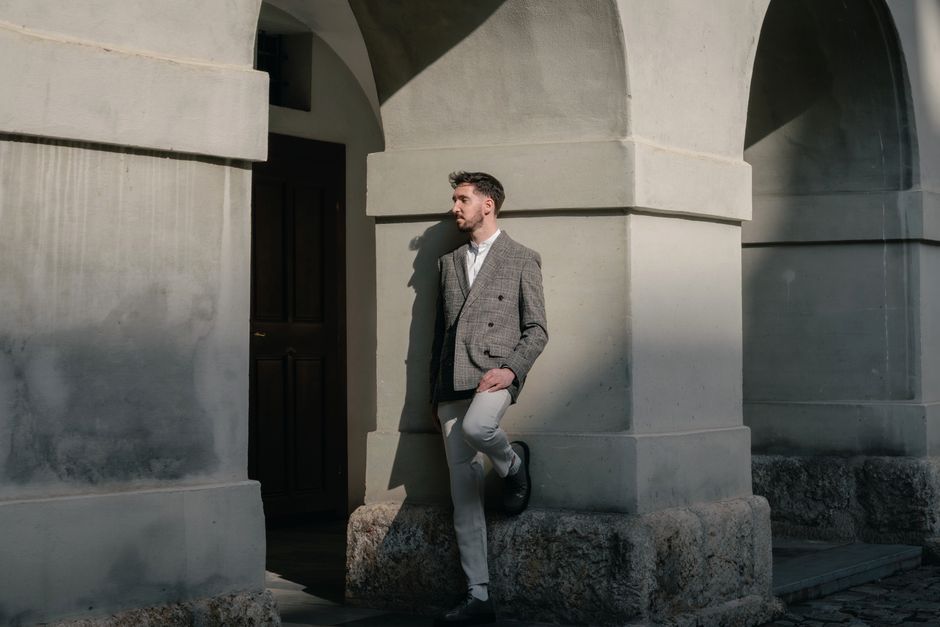
Ignore the size label until you check the garment itself. Blazer sizing varies sharply between brands, and a relaxed cut can be roomy in the torso but narrow through the sleeves. Measure a jacket you already wear comfortably, then compare its flat measurements with the product chart.
Check the shoulder seam first
- The seam should sit within about 1 centimeter of the point where your shoulder turns into your arm.
- For a deliberately relaxed shape, allow up to 2 centimeters beyond that point, but stop if the sleeve head slopes sharply.
- Try the blazer over your thickest expected office layer, such as a 2-millimeter merino sweater. If the lapel rolls outward, size or cut is wrong.
Then measure sleeve, hem, and closure
- A sleeve should expose roughly 1 to 1.5 centimeters of shirt cuff when your arms hang naturally.
- The hem should cover the waistband and finish around the upper hip for the safest desk proportion.
- Button the jacket once while seated. The front should close without a diagonal stress line, but it should not hang so loose that the lapels float away.
These checks prevent the two most common mistakes: buying a jacket that is technically oversized but still restrictive in the arms, or buying a soft blazer so loose that it reads as outerwear.
A price-and-risk comparison of soft-shoulder blazers
Price is only one part of the decision. Fabric, lining, return rules, and shoulder structure determine the real value. The figures below are reference prices shown by the brands for 2026; sales, tax, country, and stock can change the total.
What the current comparison shows
The exclusions that change the value
The COS option is my clear desk-day pick because the elastane adds recovery and the relaxed cut leaves room for a fine knit. Everlane gives more coverage, but its oversized line and shoulder pads can look too broad on a petite frame; sale versions may also be final sale. Theory supplies the cleanest formal shape, but its nipped waist and peak lapels move away from the soft-shoulder brief. Treat that last option as a backup when the dress code demands sharper tailoring.
My verdict: choose a soft wool blend over a floppy knit

For a typical late-winter office, choose a soft-shoulder blazer in a midweight wool blend with 2% to 5% stretch, a partial or full lining, and a hem that reaches the upper hip, because that combination gives enough body for professional clothes while staying comfortable during long seated hours.
The winning risk tradeoff
The winning tradeoff is controlled softness: the jacket should bend at the shoulder and elbow, but the lapel, front edge, and sleeve opening should keep their shape after you sit, stand, and put on a coat.
When to choose a different category
Do not buy this style if your main problem is outdoor exposure, rain, or a freezing commute; a wool coat, quilted liner, or water-resistant shell solves that risk better than any blazer and will protect the garment from salt, slush, and repeated wet-weather wear.
A blazer also fails as a substitute for a cardigan when your office is very warm and your dress code is casual, since even a relaxed jacket can feel too formal after several hours at a desk.
Mistakes that make a relaxed blazer look careless
Soft construction is forgiving, but it does not erase proportion problems. Most disappointing purchases fail at the boundary between ease and lack of control.
Five failure modes to catch before checkout
- Too much shoulder width: A drop of more than 3 centimeters can make the sleeve look detached and turn relaxed tailoring into borrowed clothing.
- Thin fabric with no recovery: Lightweight jersey may feel pleasant in a fitting room, then develop elbow bags and a collapsed lapel after one long day.
- A sleeve that covers the hand: This makes the whole jacket look one size too large. Alter the sleeve or choose a shorter cut.
- Over-layering: A chunky cable sweater under a soft blazer usually creates arm restriction. Use a fine merino, silk knit, or smooth cotton base instead.
- Ignoring care: Wool blends that say dry clean only need a hanger, airing time, and a fabric brush between cleanings. Washing them at home can distort the lining and shoulder line.
When not to buy another blazer
Skip the purchase if your current closet already contains two jackets that work with your trousers, or if you need a true winter layer rather than an indoor finishing piece. A dark cardigan with a clean placket may solve the same meeting-to-desk problem at a lower cost, while a lightweight trench is more useful for wet commutes. The correct purchase closes a real wardrobe gap; it should not duplicate a jacket that already fits.
How to wear one from the train platform to 6 p.m.

How do I layer a soft blazer for a cold morning?
Start with a close-fitting base layer, then add a fine merino crewneck or mock neck. Leave enough room at the biceps for movement, and put the blazer under a coat with at least 2 centimeters of ease across the back. A scarf should sit outside the lapels rather than bunching inside them. This keeps the shoulder line visible once you remove the coat indoors.
Which trousers keep the outfit balanced?
Pair a softly shaped blazer with trousers that have one clear feature: a straight leg, a gentle wide leg, or a pressed front crease. Avoid matching an oversized jacket with extremely voluminous pants unless the blazer has a shorter hem. Dark denim can work in a casual office, but a wool trouser or polished cotton pair makes the outfit read more intentional.
How can I move from work to dinner?
Remove the office knit, keep the blazer over a simple silk or cotton shell, and change only one visible element such as earrings, shoes, or a belt. For a polished result, the COS relaxed wool-blend blazer is the strongest practical choice; for formal settings, the Theory Etiennette gives a sharper waist and lapel. The category will keep moving toward lighter construction and better stretch, which is good news for office wardrobes built around long days and changing temperatures.